
Ziva Dynamics x Growth Debt
From a Visual Effects Career to a Unity Acquisition: How Growth Debt Helped Ziva Cross the Finish Line
Creative Software | Growth Debt | Strategic Exit
Ziva Dynamics was founded in Vancouver in 2015 with a vision that was equal parts scientific ambition and creative passion: to bring the world’s most advanced character simulation technology out of the hands of a few elite studios and into the mainstream. Over seven years, co-founder and CEO James Jacobs and his remarkable team built software used in more than 50 major film and television productions, won an Academy of Motion Picture Arts and Sciences Technical Achievement Award, and ultimately delivered a meaningful exit to Unity Technologies in January 2022.
This is the story of that journey, and the role that growth debt financing from our previous fund played in helping Ziva cross a critical bridge on the path to that outcome.
“We wouldn’t have made it across the finish line if we didn’t receive the funding from you guys. That ended up being a real lifeline for us at that point in time. You guys are definitely an important part of that story.”
James Jacobs, Co-Founder and CEO, Ziva Dynamics
At a Glance
Founded: 2015, Vancouver, BC
Sector: Creative Software (Vertical SaaS)
Growth Debt Financing: 2018
Equity Investors: Millennium Technology Value Partners, Grishin Robotics, Toyota Ventures
2020 Seed Round: $9.8M CAD
Exit: Acquired by Unity Technologies, January 2022
The Origin: From Avatar to a Company
James Jacobs spent 20 years in the visual effects industry before founding Ziva, starting in the mid-1990s and working his way through some of the most technically demanding productions ever made. At Weta Digital in New Zealand, he and colleagues developed the proprietary tooling used to simulate the main characters in Avatar, building a finite element simulation framework to represent elastic solids, muscles, fat, and skin with a level of physical accuracy the industry had never seen at that scale.
But the industry was changing. Studios were moving toward off-the-shelf software, consolidating around fewer proprietary toolsets, and the craft that had made the work so intellectually compelling was being commoditized. After returning to Vancouver and facing a layoff, Jacobs made a decision that would define the next decade of his life.
“I sort of imagined the future. By my current age I’d be earning half of what I was and doing half of what I was interested in. So I thought, if this is my chance to make a go of it, then this is the moment.”
James Jacobs
His severance package helped give James the runway to start Ziva Dynamics. He took no salary in the early months. The company had been born.
James was the first to acknowledge that the quality of Ziva’s outcome was inseparable from the quality of its people. The co-founding team was assembled deliberately and with the kind of intellectual honesty that defined the company’s culture throughout.
The team Ziva built over the following seven years reflected that founding philosophy. By the time of the Unity acquisition, Ziva had grown to over 60 people, with an unusually high concentration of PhDs and Masters-level researchers for a company of its size and geography. The work, spanning physics simulation, linear algebra, vectorized computation, and machine learning, attracted people who could have taken roles at Autodesk, Nvidia, Meta, or Google, and many did after the acquisition. At Ziva, they stayed because the problems were genuinely hard and genuinely interesting.
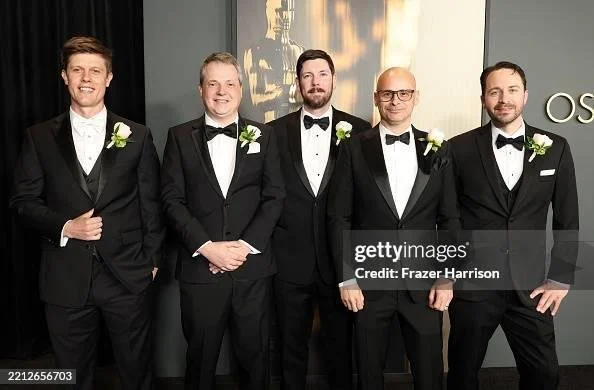
The Ziva Dynamics team at the Oscars
The Technology and the Market
At its core, Ziva’s technology was a bio-mechanical simulation platform that could faithfully replicate the behaviour of muscles, fat, and skin in digital characters. This allowed animators to focus on the acting and performance of their characters and while Ziva solved the physical realism.
The initial market was high-end visual effects. The longer-term vision was gaming. Between those two markets sat the machine learning bridge that made both possible: taking simulations that required hours of computation and compressing them into real-time performance using the kind of ML approaches Jacobs had begun exploring at Weta.
Ziva’s software was mature enough for expert users in visual effects by the early years of the company. The technology appeared in Game of Thrones, Godzilla vs. Kong, and dozens of other major productions. Spider-Man: Miles Morales and Hideo Kojima’s Death Stranding 2 were among the first major games to use Ziva’s real-time capabilities.The visual effects market, while prestigious, was small. The gaming market was enormous but tied to console release cycles, which meant Ziva spent years building toward an inflection point that arrived with the new generation of consoles in 2020.
The Capital Raising Journey
Raising capital for a company building complex proprietary software from Vancouver proved difficult. Canadian venture investors were less interested in the kind of technology Ziva was building. US investors, meanwhile, were rarely interested in companies based more than 30 miles outside of San Francisco. As Jacobs put it: “Vancouver might as well have been on the moon.”
The Decision to Take Growth Debt
In 2018, with Ziva at a pivotal stage of its development, the company was introduced to the team behind Coho Growth.
“Ziva had strong fundamentals, which we have always cared deeply about: growth, high retention, and low burn. Beyond that, the management team was passionate about solving the problems their customers faced and were motivated and resilient to drive the business to an exit. The nature of the company’s proprietary technology also helped create a moat and defensibility that we thought would ultimately lead to a meaningful outcome for all stakeholders.”
- Rob Foxall, Co-Founder, Coho Growth
For James, the $2M facility was more than capital. It was the first institutional support Ziva had received, and it came at a moment when the company was trying to bridge a critical gap between its visual effects origins and the gaming market it was building toward. Over 90% of the proceeds went directly to salaries, funding the engineering team doing the hardest work of the company’s existence.
“I am forever indebted to Mike Walkinshaw, who was really great at backing me up and making sure things didn’t go sideways. He was really helpful and I really appreciate that.”
James Jacobs
Mike Walkinshaw, Rob Foxall, and Mark Bakker worked closely with James and the Ziva team through the years that followed, providing not just capital but encouragement and support during a period that tested the team in every way a startup journey can.
“You guys really did help with that outcome, very tangibly. When I talk about the people that helped get us to the successes we had, you guys are definitely an important part of that story.”
James Jacobs
The 2018 growth debt facility was deployed with singular focus. Ziva invested it in the product re-engineering and go to market activities to enable the focus on real-time gaming applications. The machine learning work that would eventually enable Ziva-powered character simulation.
The Unity Acquisition
Ziva’s relationship with Unity had begun as early as 2017, when the company’s sales lead Michael Smit opened conversations around testing Ziva’s real-time solver inside the Unity engine. Those conversations percolated slowly until Unity, in the process of building out a creative tooling ecosystem, began to see Ziva as a crucial missing piece.
Unity had just completed the acquisition of Weta Digital’s tools and pipeline for over $1.5B. What they needed next was a way to take offline, high-fidelity simulations and make them fast. That was precisely what Ziva had spent seven years building.
The acquisition was announced in January 2022. Every employee who held options received value from the transaction. It was, in James’s own words, “a very meaningful exit for the whole company.”
“Becoming part of Unity means that Ziva’s technology will be able to do more and be more. We would be able to reach a much larger audience of 3D content creators.”
James Jacobs
The Outcome
Ziva Dynamics was acquired by Unity Technologies in January 2022, representing a strong outcome for every stakeholder: founders, employees, and equity investors including Millennium Technology Value Partners, Grishin Robotics, and Toyota Ventures. Our previous fund was repaid and participated in that outcome.
The company had raised just~ $14M CAD in total across its lifetime, a fraction of what a comparable company in the Bay Area tackling similar problems would have consumed. That capital efficiency was a reflection of the team’s discipline, focus, and the quality of engineering that made Ziva’s product genuinely irreplaceable.
“This is totally a shared victory through the efforts of a whole team. I don’t want to make it seem as if I’m the reason for this. There are many crucial people in that recipe.”
James Jacobs
After the Unity acquisition, James and a group of former Ziva colleagues, many of whom he had worked with since before Ziva was founded, regrouped to form C-53, a small Vancouver-based games studio. The company’s first title, BigTama, is a multiplayer VR game built on proprietary game engine and sandbox gameplay, designed to push visual quality in VR beyond what commercial engines can currently achieve.
C-53 is bootstrapped by design, a deliberate choice by a team that has done the full startup journey and knows the cost of giving up control of the thing you love building.
“The exit was great because we were able to make all of our investors whole and make sure our team got something for the effort they put in. But the bad thing is, all of a sudden you can’t continue to do the things you like doing when it’s no longer yours. We wanted to start something where we could potentially not have to give up the thing we love doing in order to make a living.”
James Jacobs

Rob Foxall is a Co-Founder and Managing Director at Coho Growth
Rob is a relationship builder with a passion for helping founders and operators grow their software companies.
